

Human Review & Confidence
How Prisma detects ambiguity and escalates to a human expert instead of guessing
The hardest interactions are the ones that aren't clearly right or wrong. A forced pass/fail hides them — the label gets picked and the doubt disappears. Prisma is built to surface them. This is where oversight intelligence earns its name: the platform knows when it isn't sure, and it does something deliberate about it.
Confidence, not just a verdict
When a metric validates an interaction, it can come back confident or not. A confident result is recorded and done. An ambiguous result triggers a second, more careful pass — a re-evaluation that brings in the relevant context Prisma holds about your domain (Knowledge and Controls) before deciding again.
A worked example
Recall the hedged reply from Validation: "There may be a charge — please check your account terms." The Disclosure adherence metric can't confidently call it adherent or a breach, so it returns ambiguous. Here's what happens next:
- Re-evaluation. Prisma takes a second, closer look — this time with the relevant deposit-disclosure policy and any related Controls in front of it. If that resolves the doubt, the result is recorded and that's the end of it.
- Still unsure → an expert. If it's still ambiguous, it becomes a review request. A compliance reviewer sees the interaction, the policy it was measured against, and the platform's reasoning, then decides: breach — the reply must state the loss of accrued interest, not just "a charge." They record why.
- The decision sticks. That judgement becomes a Control, so the next hedged disclosure like it is far more likely to be resolved without a human at all.
Escalation to an expert
When a case does reach a human, the job is to make the judgement fast and accountable — not to re-do the platform's work. The reviewer sees:
- The interaction — exactly what was asked and answered.
- What it was measured against — the metric and the policy in play.
- The platform's reasoning — why it landed on ambiguous, and the context it weighed.
The expert picks a verdict and records the reason. That keeps the people accountable for the judgement in the loop precisely where judgement is needed — on the genuinely hard cases — without burying them in the routine ones the platform already handled with confidence.
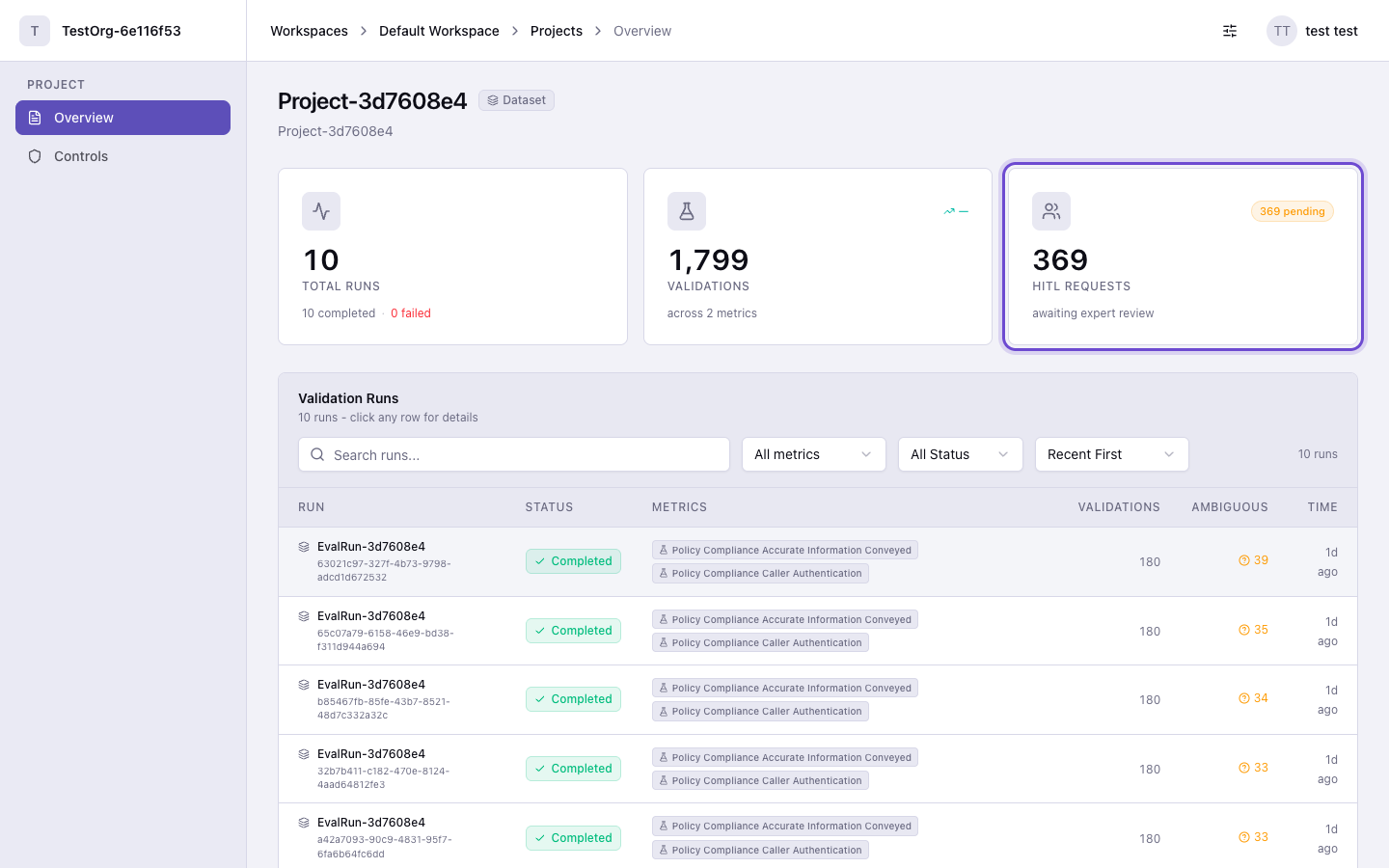
Ambiguous results collect as review requests — here, 369 awaiting an expert — instead of being silently labelled.
It compounds
That decision isn't discarded once it's made. It feeds Controls, so cases like it stop coming back as ambiguous. As that library grows, the platform escalates less and resolves more on its own — the same earned confidence that lets you move from full coverage to confidence-based sampling. It's oversight that gets sharper with use, instead of staying static.