

Validation
Prisma's core action — every interaction scored against your policies, with a definitive or ambiguous outcome
Validation is the core action of the platform: Prisma takes an interaction, checks it against the metrics and policies that apply to it, and records what it found. The word is chosen with care. Observing an output tells you what happened; validating it measures what happened against the obligation it was supposed to meet. Prisma does the second.
That distinction is the whole point of oversight. "What did the model say?" is an observability question. "Did this meet the standard we're held to, and how do we know?" is the question a regulated business actually has to answer. Validation answers the second one.
Coverage you can stand behind
Two properties make validation suitable for oversight rather than spot-checking:
- It runs on the platform, not in your app. Your application emits the interaction and moves on; validation happens server-side, inside your Prisma instance. Nothing slows your production path, and the judgement isn't something each app re-implements.
- It covers everything by default. Prisma validates every interaction, not a sample — the baseline you need to attest to a control rather than hope a spot-check was representative.
Coverage, though, is a choice — not a fixed cost. As Prisma accumulates Controls and gains confidence in your domain, you can move from full coverage to confidence-based sampling: keep 100% where the risk is high, and sample the routine cases the platform has already learned to handle well.
That's the opposite of sampling as a cost-saving measure — checking less because checking everything is expensive, with no way to know what the gaps hid. Prisma starts at full coverage and samples only what it has earned the confidence to sample. Sampling becomes a product of oversight intelligence, not a substitute for it.
What a validation produces
Each metric applied to an interaction produces a result with three parts:
- A verdict — the metric's chosen answer from its defined options (for example correct / incorrect, or adherent / breach).
- A score — that verdict's value on a 0–1 scale, which is how a result reads as a pass, a fail, or something in between. You set this when you author a policy metric.
- The reasoning — why the metric landed where it did. Oversight that can't explain itself isn't oversight; every validation keeps its rationale so a person can review it.
Nothing is thrown away. The verdict, the score, and the reasoning are all retained, which is what lets a result be audited later rather than just counted.
A worked example
A customer asks whether they can withdraw early from a 12-month fixed-term deposit. The assistant replies: "Yes — early withdrawal is allowed, with a 2% penalty on the balance."
A Disclosure adherence policy metric validates that reply against the deposit's terms:
- Verdict — partial
- Score — 0.5
- Reasoning — "The penalty is stated, but the loss of accrued interest required by the deposit terms is not disclosed."
The same metric has clear scores for its other verdicts, so any result reads immediately as a pass, a fail, or something in between:
| Verdict | Score | Reads as |
|---|---|---|
adherent | 1.0 | Pass |
partial | 0.5 | Neutral |
breach | 0.0 | Fail |
ambiguous | — | Routed to review |
Now a different reply hedges: "There may be a charge — please check your account terms." The metric can't confidently call this adherent or a breach. Rather than guess, it returns ambiguous and the interaction is routed onward — covered next.
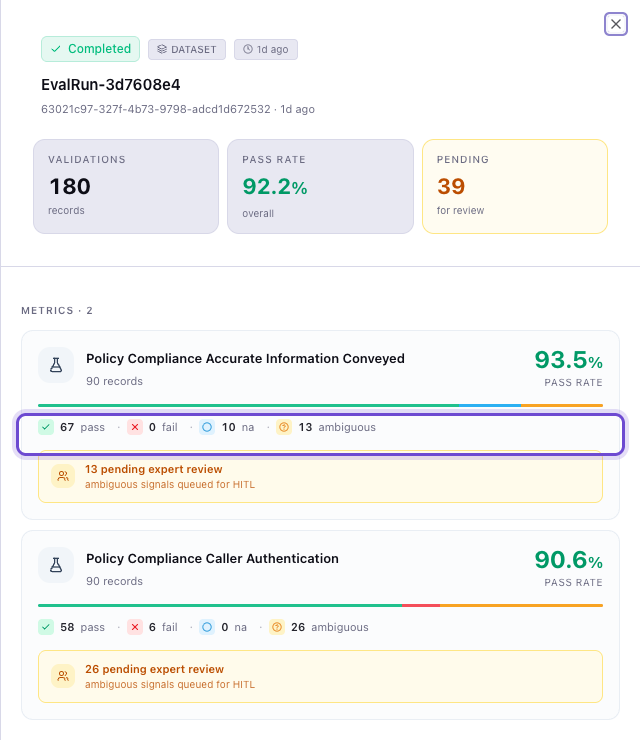
A run's metric breakdown: each verdict is counted, and the ambiguous ones are routed on for review.
Definitive or ambiguous
A validation result is one of two kinds, and the second is what separates Prisma from a binary scorer:
- Definitive — the metric reached a confident verdict. It's recorded as a pass or fail and that's the end of it.
- Ambiguous — the metric could not confidently decide. Prisma does not force a guess. It marks the result ambiguous and routes it onward.
A tool that must answer pass-or-fail will quietly mislabel exactly the cases that matter most — the borderline ones where judgement is required. Treating "not clearly either" as a real, recorded outcome is what makes oversight trustworthy. What happens next to an ambiguous result — a careful re-check, then escalation to a human expert — is covered in Human Review & Confidence.
Runs
Validations are grouped into runs. A run carries the set of metrics to apply and collects the results — for a stream of live interactions in a real-time project, or for a batch of uploaded ones in a dataset project. The run is the unit you work with in the dashboard: each project's Validation Runs show how many interactions were validated, how many came back ambiguous, and how many are awaiting expert review — and you can open any run to read the individual verdicts and their reasoning.
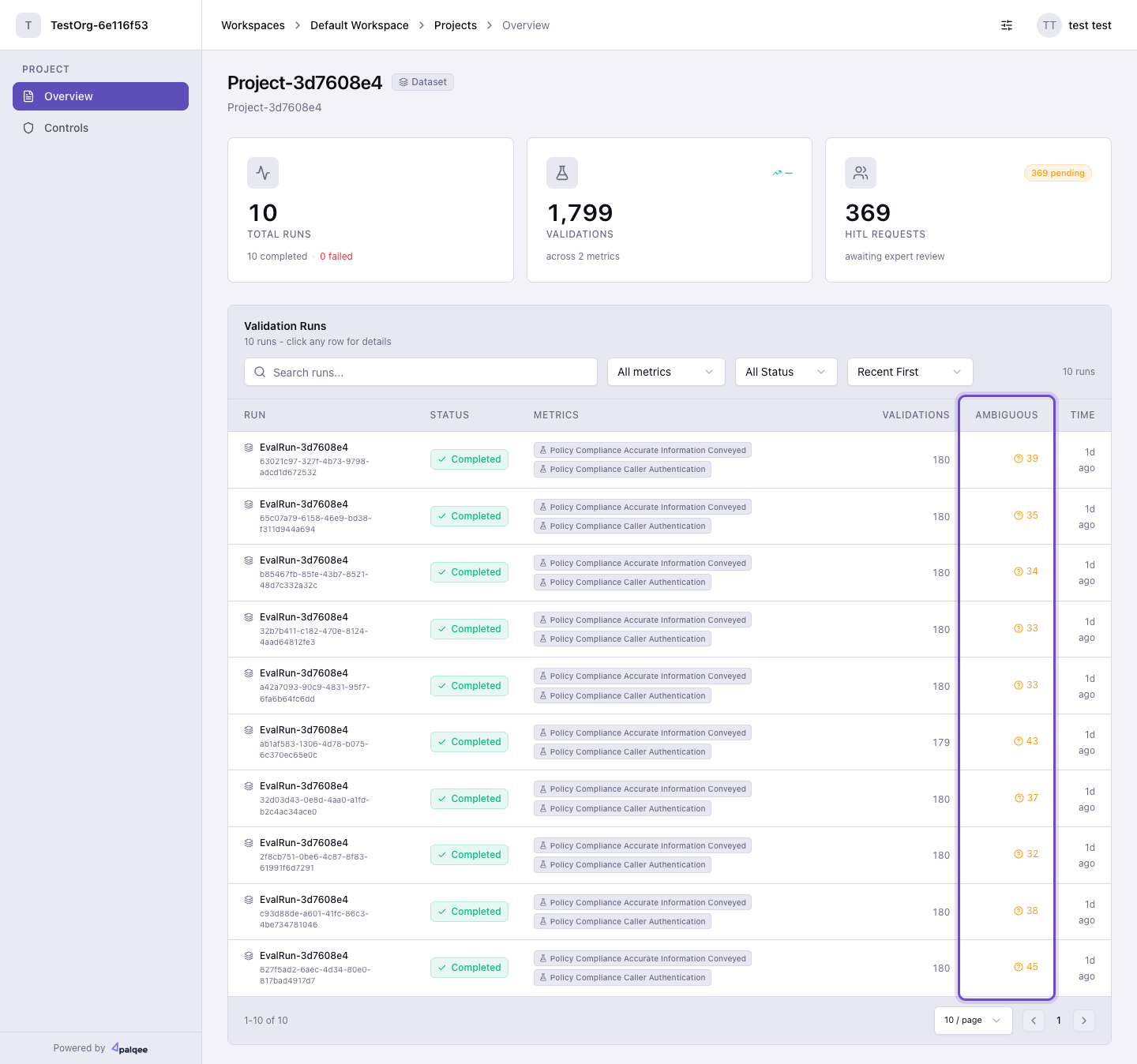
Every run is validated against its policy metrics. The highlighted Ambiguous column is the count of results the platform wouldn't force into a pass or fail.
Validation is transport-agnostic
The same validation runs whether an interaction arrived as a live trace, a logged human-workflow record, or a row in an uploaded dataset. How interactions get in is an Interactions concern; what happens to them here is identical.